
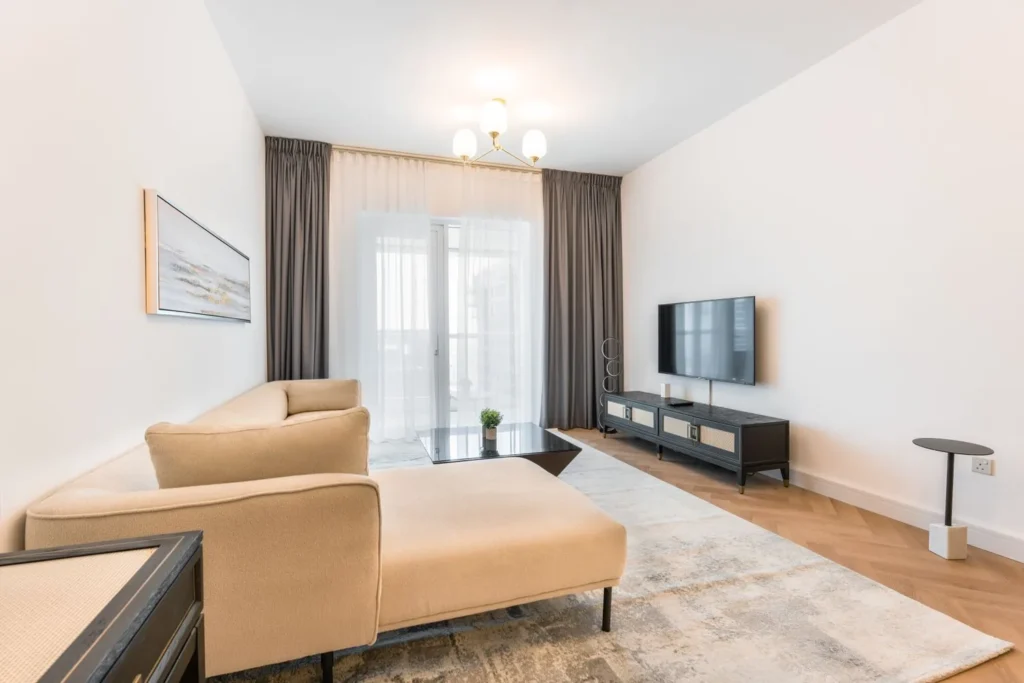
To let an apartment in Warsaw safely, set the rent from similar listings nearby, prepare a clean apartment in good working order, talk to applicants about income and plans, sign a written agreement (ideally an occasional tenancy) and complete a handover report with photos and meter readings. Rental revenue is taxed at a flat 8.5% up to PLN 100,000 a year.
Setting the rent
Compare your apartment with listings of similar size, number of rooms and standard within a few hundred metres. Rent depends on, among other things:
- distance to the metro, trams, universities or office districts,
- furniture, appliances and air conditioning,
- a balcony or terrace, parking, the floor and a lift,
- the condition of the building and surroundings,
- the length of tenancy you want.
In the listing, state the rent separately from the charges: the service charge to the residents’ association or cooperative and metered utilities. Tenants compare the total cost, and unclear charges put them off.
Preparing the apartment
The apartment should be clean and in working order. Check the electrics, taps, boiler or water heater, locks and windows. Remove personal belongings and leave only what you are letting. Take good daylight photos and describe the apartment as it is.
Decide the rules in advance: pets, number of occupants, smoking, subletting and how utilities are settled. Put them in the agreement, not just in conversation.
Check your insurance too. A landlord’s policy usually does not cover the tenant’s belongings or the tenant’s liability to neighbours, so some landlords ask tenants to take out their own liability cover.
Assessing a tenant
Checks should be proportionate and comply with data protection law. In practice this means a conversation about the source of income, the planned length of stay and who will live in the apartment. You may ask for confirmation of employment or income, but do not copy documents you do not need. Put what you agree into the lease: who lives there, from when and for how long.
The tenancy agreement
The agreement should set out:
- the parties, the address and a description of the apartment,
- rent, additional charges and payment dates,
- the deposit and refund terms,
- the term and notice rules,
- who is responsible for minor and major repairs,
- rules on pets, subletting and alterations.
An individual letting privately can sign an occasional tenancy agreement, which makes it easier to recover the apartment if the tenant does not pay. It requires the tenant’s notarial declaration, an alternative address with consent from its owner (or another person with legal title to it) and notification of the tax office within 14 days. See Occasional tenancy in Poland step by step.
When you sign the lease, give the tenant a copy or printout of the apartment’s energy performance certificate (świadectwo charakterystyki energetycznej). The duty comes from Article 11 of the Polish act on the energy performance of buildings (in Polish), which also lists the exemptions. If you do not have one, order it from a certified assessor well before viewings start.
The handover report
The handover report is the key document when settling the deposit. It records meter readings (electricity, water, gas, heat), an inventory with condition notes, the number of keys handed over and photos of every room. Both parties sign it on the day the keys are handed over. At the end of the tenancy a return report is compared with the first one.
Tax on rental income
Since 2023 private rental income is taxed only with the lump-sum tax on recorded revenue: 8.5% of revenue up to PLN 100,000 a year and 12.5% above that. Costs are not deducted. Advance payments are due monthly by the 20th of the following month (or quarterly if eligible), and the PIT-28 return is filed between 15 February and 30 April of the following year. Spouses with joint property may choose for one of them to report all of it, in which case the higher rate applies only above PLN 200,000. The statement is due by the 20th of the month after the first rental revenue of the year (by 31 December if that revenue arrives in December), not with the annual return. Source: Ministry of Finance (in Polish). See also our rental tax page.
| Monthly rent | Annual revenue | Tax at 8.5% |
|---|---|---|
| PLN 3,000 | PLN 36,000 | PLN 3,060 |
| PLN 4,000 | PLN 48,000 | PLN 4,080 |
| PLN 6,000 | PLN 72,000 | PLN 6,120 |
During the tenancy
The tenant should know whom to call when something breaks. A regular, announced visit lets you spot problems early. Before the lease ends, decide whether to renew: a good tenant who pays on time is worth a conversation about new terms, because every empty month costs money.
Common landlord mistakes
- An oral agreement or an unadapted template from the internet. In a dispute what counts is what was written, and generic templates often leave out the deposit, repairs and notice.
- No handover report with photos. Without one it is hard to deduct damage from the deposit.
- An occasional tenancy not notified within 14 days. The agreement then loses its main advantage.
- Rent set by guesswork. Too high means weeks without a tenant; too low is a loss for the whole tenancy.
- Forgotten tax. Advance payments are due during the year, not just with the annual return.
- No single contact for emergencies. A tenant who does not know whom to call repairs things themselves, or not at all.
Frequently asked questions
Should I take a deposit?
Yes, a deposit secures amounts owed to the landlord. For an occasional tenancy it may not exceed six months’ rent. In Warsaw one or two months’ rent is typical.
Can I hand the management over to an agency?
Yes. It can cover the listing, viewings, agreements, rent collection, bills and day-to-day matters. See Property management.
Is the service charge part of my revenue?
It depends on how the charges are written into the agreement. Agree this with your accountant before signing.
Legal status: November 2026. This guide is general information, not legal or tax advice.
Warsaw Estates, run by Aleksander Dutkiewicz, lets and manages apartments in Warsaw. Want to let your apartment? List it or call +48 500 049 000.